

Key takeaways:
1. Local digital presence is how a business shows up in searches by people nearby, with brand information tied to a specific physical address, such as its location and business hours.
2. In chains with multiple locations, people searching on Google judge each address on its own. A single location with wrong or outdated information can tarnish how people see the entire brand.
3. Updating location information one listing at a time only works up to a certain chain size. Large chains need to centralize management, keep an ongoing review routine, and track metrics for each location.
A good-looking website and an active social media presence don't, on their own, add up to a complete digital presence, especially if you depend on a physical address to sell.
Local digital presence means showing up on the channels people use to look for businesses, products, and services near them. That includes platforms like Google Maps and Waze.
The job scales with the business: for a single-address business, digital presence is a task. For a chain with dozens or hundreds of locations, it's an operation that involves multiple listings and close attention to detail.
In this article, we'll take a closer look at what local digital presence is, its main types, practical examples, and how to audit and structure it when your business has more than one address.
What does local digital presence mean?
Local digital presence is how a business shows up and gets found online for a specific physical location, such as a store, branch, clinic, or office.
There are two types of digital presence. They start from the same foundation but differ on one key point:
- Generic digital presence: website, social media, content, and ads, focused on the brand in the abstract, with no link to a specific address.
- Local digital presence: the same foundation, plus data such as location, business hours, and distance from the person searching.
For example, a restaurant with great social media but no up-to-date Google Business Profile has an incomplete digital presence for the people who matter most: someone five minutes away deciding where to have lunch.
Why does digital presence matter when a business has multiple locations?
Because people searching on Google see and judge each location separately, not as part of a whole.
If someone searches and finds a specific location with wrong or outdated information, they have no way of knowing that the chain's other locations are in good shape.
That's why a company with multiple stores or franchises has to manage the digital presence of every address, not just the brand as a whole. When a single store has wrong information, old photos, or neglected reviews, the problem doesn't stay confined to that location.
Anyone who has that bad experience carries it over to the entire brand, even if they've never had any contact with another location.
4 ways to grow your brand's digital presence
Local digital presence isn't about investing in just one marketing channel. Here are the types of digital presence that, together, strengthen the online presence of brands and their locations:
1. Google Business Profile
A Business Profile is usually the first point of contact between a local business and the people searching for it. That's because the listing appears directly in Google Search and on Google Maps, bringing together information such as address, business hours, photos, and reviews.
Without a complete, up-to-date profile for each location, the business simply won't show up in a significant share of local searches, and the brand loses sales.
2. Website and social media
Your website serves as the brand's official home base, while social media brings the business closer to its audience and helps build relationships.
For companies with multiple locations, consider whether each store needs its own page (with its specific address and contact details) or whether a central website with a "locations" section is enough. Weigh the same question for social media profiles.
3. Local directories and apps
Beyond Google, apps like Waze and other local directories are also important touchpoints, especially for people who have already decided to visit and are looking for directions.
Consistent address and contact information across these apps keeps people from turning back halfway there because of an outdated detail.
4. Reviews and online reputation
Reviews show up on the Business Profile and on Google Maps, and more and more, they directly shape searchers' decisions. A location with no reviews, or with negative comments left unanswered, weakens the digital presence of that specific store, even if everything else is in order.
Also read: 5 common mistakes when responding to negative reviews
Digital presence: practical examples
The best way to understand this concept in practice is to compare two opposite scenarios. So let's walk through an example of local digital presence with Vida Bem, a fictional pharmacy chain with ten locations spread across the city.
What does a chain with consistent presence across locations look like?
Someone searches for "pharmacy near me" and Google shows them the nearest Vida Bem location. When they click, they see a complete profile:
- Recent photos of the store.
- Correct business hours (including that week's holiday).
- Reviews that the team has replied to.
Because the information is complete and correct, the location inspires trust and makes the decision to visit easier.
Later, the same person runs a new search in another part of the city and finds a different Vida Bem location. The profile meets the same quality standard: up-to-date information, recent photos, and reviews with replies.
That's what consistent digital presence across locations looks like: no matter which address shows up in search, the person finds reliable information and a similar experience with the brand.
What happens when presence is inconsistent across locations?
Now imagine that only three of Vida Bem's ten locations have a well-maintained profile. The other seven have old photos, wrong business hours (the store shows as closed when it's actually open), and negative reviews that nobody has answered.
If the person searching happens to land on one of those seven outdated locations, they won't think, "Oh, this particular store is a mess." More likely, they'll conclude that the Vida Bem chain as a whole is disorganized, without knowing that the other three stores are in good shape.
That's the risk of taking care of your digital presence only at launch and then letting it slide. Over time, problems at a few locations can end up hurting the reputation of the whole chain.
Also read: How to ask customers for Google reviews
How do you build digital presence for a business with multiple locations?
The simplest way to build a solid local digital presence is to follow the same process every time a new location opens. Here's a basic step-by-step process for structuring that presence from day one, and how to avoid common mistakes:
- Create (or claim) the Google Business Profile with the right address and category.
- Make sure the website has a dedicated page or section for each location.
- List the address on the relevant local apps and directories.
- Set up a process to start collecting the first reviews as soon as the location opens.
How do you standardize information across your Google Business Profiles?
For this strategy to work, you can create a standard set of information to replicate across your location listings. To do that, decide in advance:
- Which name should be used for every store.
- The Business Profile category.
- The format and tone used to respond to reviews.
We recommend against treating each new location as a one-off: following the same standard helps you avoid brand positioning mistakes from the start.
How do you audit your local digital presence?
An audit means checking a specific set of information location by location, then comparing the results across stores, rather than just looking at the chain's overall average. A basic audit involves checking whether:
- The Google Business Profile is complete and has the right category.
- The name, address, and phone number match across every channel.
- The photos are up to date.
- Recent reviews have replies.
When you spot inconsistencies, three signs help confirm that the problem is no longer isolated:
- Locations whose information differs between the website and Google.
- Many negative reviews concentrated at a few addresses.
- No one assigned to keep each listing up to date.
When these signs show up at more than one location at the same time, it's no longer a one-off problem: it has become a structural challenge for the company.
Also read: Google Business Profile categories: how to choose the right one
How do you improve digital presence at scale?
Once you've identified the inconsistencies, the fix also has to be planned at scale, not location by location. Here are a few guidelines for doing that:
1. Centralize management of all locations
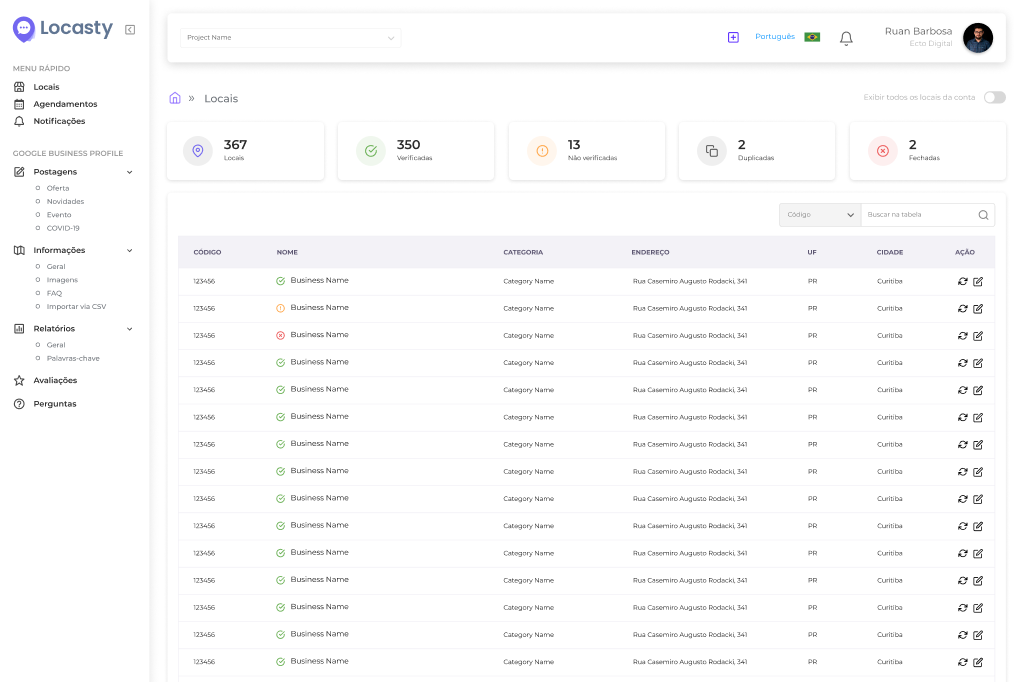
Having a single place to view and edit information for every location, without opening each listing one by one, is what turns fixing things into a sustainable routine.
Fixing one listing at a time works for a handful of locations, but it becomes a real challenge for store chains and franchises.
2. Keep an ongoing maintenance routine
Local digital presence isn't something you fix once and forget: hours change on holidays, photos get old, and new reviews come in every day. Setting a fixed schedule to review all of this is what keeps your digital presence solid over time, even as the chain grows.
3. Track metrics for each location
Looking only at the chain's overall results hides exactly which location is dragging the average down. That's why it's important to:
- Track metrics such as average rating.
- Check review volume and profile completeness at each store.
- Compare how these numbers change over time.
This lets you spot a problem before it affects how people see the whole brand, instead of finding out only when someone complains.
The hard part is pulling these numbers together: without a dashboard that brings all the data into one place, each metric lives in a different channel, and comparing locations one by one turns into slow, manual work.
How can Locasty help structure your chain's digital presence?
With Locasty, you automatically distribute each store's information to the main local directories, such as Google Maps, social media, and search engines, without re-entering it on every platform or setting up a new structure from scratch.
Locasty's bulk actions let you update or publish content across multiple locations in seconds. The consolidated strategic view shows up to 18 months of historical data by region or by physical location, so you can see exactly where your digital presence is weakest.
Schedule a Locasty demo and see firsthand how it can help your chain!
Also read: Local SEO guide: strategies to make your business stand out
Cover image — Source: jcomp / Magnific.com (2026)



0 comments