

Key takeaways:
- A location's reputation doesn't stay contained to that location: a bad experience at a single address can shape how people see the entire brand.
- A one-off drop (a staff change, a renovation) reverses on its own; a systemic drop persists and points to a structural problem.
- Tracking only the network's overall average hides the outlier location, which only shows up when you compare location by location.
_____________________________________________________________
Picture someone searching Google for the name of a franchise brand. The results show the nearest location, with a low rating and recent reviews complaining about customer service.
This person has never set foot in that particular location, yet they've already decided not to go because of the bad reviews. In their mind, there's no "that location." There's only the brand.
This happens more often than you might think, and it's exactly why the reputation of a single address can affect the entire network, even when the other locations are doing well.
Keep reading to learn what reputation on Google is, why it matters so much for multi-location brands, how to check it in practice, and, above all, how a single location can end up shaping how people see the whole network.
What is reputation on Google?
In short, reputation on Google is the set of public signals (average rating, number of reviews, comments, the business's replies) that form a first impression of a business before any direct contact.
These signals come from a combination of factors. The average rating and the reviews appear right below the business name, in both Google Search and Google Maps, before any description or photo.
According to the Google Business Profile Help Center, the number and quality of reviews directly influence how prominently a profile shows up in local results. In other words, reputation isn't just a matter of image: it also affects who finds the business in the first place, before anyone decides whether to visit.
But once there's more than one location, looking after your reputation stops being simple, even if the network has good reviews on average.
With a single address, managing reputation means keeping an eye on one profile. In a network, it means keeping an eye on dozens or hundreds of profiles, each one collecting reviews at its own pace, with no automatic sync between them.
This is exactly where managing your reputation on Google turns into an ongoing operation that needs a defined process.
How do you check a business's reputation on Google?
Before any management strategy, you need to know where the network stands today. Here's how to check, both for businesses with a physical address and for e-commerce operations:
How to check whether a franchise has a good reputation (location by location)
The simplest way is to search Google for the name of each location (or open the matching Business Profile) and look at three signals:
- the average rating;
- the number of reviews;
- the business's response rate.
A location with a high rating but only a handful of reviews is still on shaky ground: a few new reviews can swing its rating sharply, unlike a location whose rating rests on a larger base of reviews.
For an online store, checking reputation on Google works a little differently. Besides the Business Profile (when there's a physical address tied to it), it's important to look at reviews linked to verified purchases on marketplaces and at store review tools built into the website.
The principle is the same as for a physical location: once public reputation takes shape, it influences the decisions of people who haven't bought yet.
Once you know how to check reputation at each level, it's easier to see why one location's problem doesn't stay contained to it.
How can one location's reputation affect the entire network?
People searching for a brand on Google rarely distinguish between "the chain" and "that specific location." Whatever happens there, good or bad, is read as an experience with the brand as a whole.
That means a location with poor service, even if it's an exception within the network, can shape the first impression of someone who has never been to any other location.
The effect is even clearer in quick decisions, like choosing between two nearby locations on Google Maps. In that situation, the person searching won't investigate whether the problem described in a review was an isolated case or a pattern at that location. They'll simply compare the ratings and pick the better-rated option.
When reputation management isn't centralized, it's common for one or two locations to pile up unanswered negative reviews while the rest of the network does fine, and nobody notices in time.
Without a report that compares location by location, these exceptions stay hidden behind the overall average, quietly dragging down how the brand looks to anyone who searches for any of its locations. Recognizing this risk is the first step.
The next step is learning to tell two kinds of problems apart: the ones that are temporary and the ones that reflect something deeper at a specific location.
How do you tell a one-off reputation drop from a systemic one?
Not every rating drop calls for the same kind of response. A location that had a bad month for an isolated reason needs a different fix than one that has been racking up unresolved problems for months.
Here's how to tell the two cases apart and what each one usually requires:
Signs that the problem is one-off
A one-off drop is usually concentrated in a short window of time, typically a few weeks, and tends to be tied to an identifiable event. Some examples:
- A recent staff change.
- An inventory problem.
- A renovation of the space.
- A peak-demand period the location wasn't prepared to handle.
The clearest sign is recovery: once the event is over, the rating climbs back up on its own, without any additional intervention.
In these cases, the fix is usually simple: resolve the one-off cause and reply properly to the reviews from that period, without necessarily overhauling the location's entire process.
Signs that the problem is systemic
A systemic drop has no single event behind it: it persists month after month, even after any one-off problem should have been resolved.
The clearest sign here is the same issue coming up again in reviews from different periods (the same kind of complaint about customer service, for example, showing up for six months with no change).
The root of the complaints usually lies in something structural at the location, such as staff training, operating processes, or even local management, and it calls for a deeper fix than simply writing good replies to reviews.
In both cases, the most reliable point of comparison isn't just the location's own history but also how the network's other locations performed over the same period.
If every location dropped at the same time, the problem is probably external to the operation (a seasonal event, for example). If only one dropped while the others held steady, the problem is local, and that's where attention needs to go first.
Diagnosing the type of drop is what lets you respond the right way. In practice, that means building a few habits into the network's routine.
Online reputation management on Google: best practices for franchise networks
Three practices help keep the problem you identified in the diagnosis from coming back:
1. Standardize how each location responds to reviews
Locations shouldn't each respond to reviews their own way, with inconsistent tone and response times.
Standardizing this (with reply templates and a single tone of voice for the whole network, for example) keeps the reviewer's experience from varying so much depending on which location received the review.
Also read: 5 common mistakes when responding to negative reviews
2. Monitor each address's reputation individually
Looking only at "the brand's reputation" hides exactly the kind of problem that most needs attention: the outlier location.
Comparing reputation location by location, and not just the overall average, is what lets you act before a specific location starts to affect how people see the rest of the network.
Also read: Store missing from Google Maps? 7 reasons and how to fix them
3. Catch dissatisfaction before it becomes a public review
A problem solved before it turns into a public review is a problem that doesn't hurt the brand's reputation. A satisfaction screening, sent before a standard review request, separates customers who had a good experience from those who ran into a problem with the service they received.
Customers likely to leave a good review can be invited to post it directly on Google. Those who signal dissatisfaction get a private contact channel instead, which gives the network a chance to fix the problem before it turns into a negative review that anyone searching for the brand later will read.
Also read: How to ask customers for Google reviews
How does Locasty help protect the whole network's reputation?
Applying these three practices by hand, location by location, is the kind of routine that falls apart over time without a structure behind it.
Without centralized visibility, it's practically impossible to notice in time that a specific location is eroding the reputation of an entire brand.
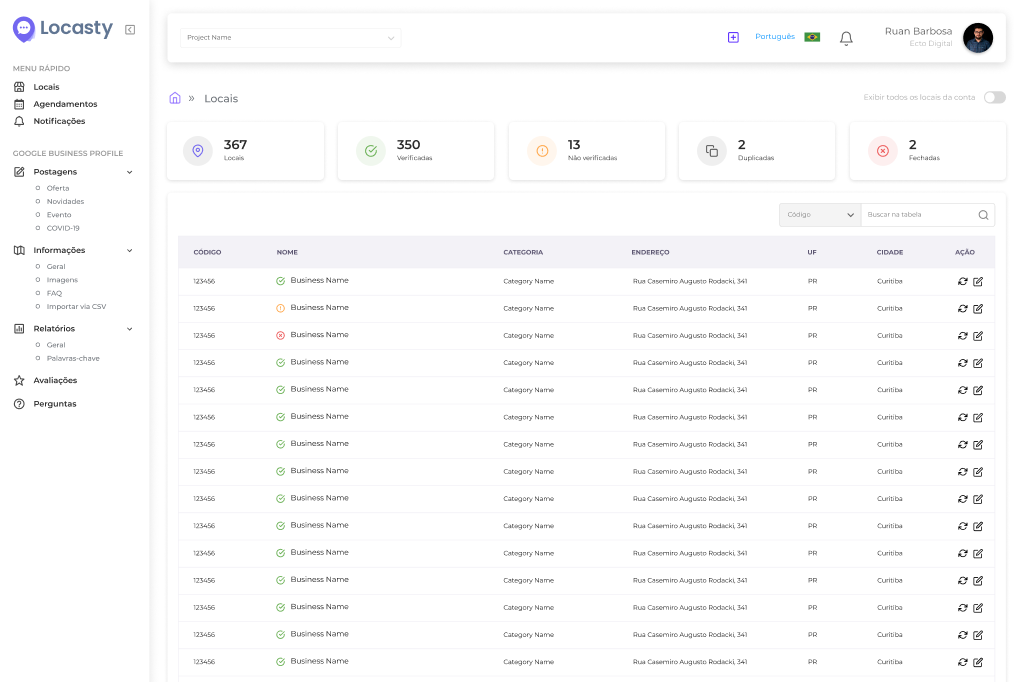
With Locasty, you track reviews from every location in a single dashboard:
- AI classifies the sentiment of each review and categorizes the reasons behind the ratings.
- The Reputation report shows how each location is trending, making it clear which specific address is an outlier before it affects how people see the entire network.
- Smart NPS applies exactly the screening described above, inviting satisfied customers to leave a review on Google and opening a private feedback channel for anyone who signals a problem.
- To respond faster, the AI assistant suggests personalized replies for each review, which your team checks and sends.
Get started for free and see how Locasty can improve your digital presence.
Also read: Local SEO guide: strategies to make your business stand out
Cover image — Source: jimbophoto / Magnific.com (2026)



0 comments